
My apologies for taking this long to consolidate and publish my notes. As you all know, cases do not stop just because you ducked out to do one of your favorite conferences. I will be dropping my session and lab notes asap.
I approached this Relativity Fest as an active customer rather than my traditional journalist/analyst role. That changed my take-aways and I hope ‘kept it real’ for fellow practitioners hopping workspaces daily. Normally I would be looking for keynote announcements with market impact on partners and competitors. This Relativity Fest, I focused on license and roadmap items that would accelerate my clients’ time to truth, reduce costs and improve upstream/downstream integrations. I am merging more specific answers from my press briefing where appropriate, so don’t think you missed something at the keynote.
Relativity Fest metrics are a good opportunity to measure platform growth:
- 1,800+ attendees, 580+ new
- 130+ new features and doubled processing speed in RelativityOne
- Relativity aiR adoption – 200+ customers, 1,500+ workspaces, 100M+ predictions

Phil Saunders
Whether on-stage or in private briefings, Phil is a straight shooter with ‘radical candor.’ Right off the bat, he acknowledged Relativity’s goal of rapid transformation vs. slow evolution. Transformation is disruptive for those who do not adapt quickly. Specifically, aiR’s transformation of review, privilege and strategy may cut into revenue from contract first pass reviewers, privilege log creation and depo/trial preparation.
Phil kind of buried the real lede in his keynote. In 2026, aiR for Review, aiR for Privilege and aiR Assist (when generally available) will be included in the standard pricing and packaging for RelativityOne; aiR for Case Strategy will have an additional cost. This is consistent with how they rolled Relativity Analytics into the volume license previously. This may encourage partners to innovate on aiR infrastructure instead of external LLM solutions.
For years, Relativity has been a data destination for relevance determination. Phil presented the vision of the platform as a system of action for early case intelligence connecting source to strategy. I see why he led with transformation. This platform vision challenges the eDiscovery market commodity model ($/GB or $/hr). An effective early case resolution platform could disrupt volume or time charges in favor of value-based fees. Manifesting this vision will require community, innovation and execution. See my write-up of the Developer Summit for the innovation strategy.

 Chris Brown – CPO

Chris did a deep dive into actual Relativity workspace growth and usage across firms, corporate and public sector customers. Litigation is a shrinking portion of global workspaces as the platform is increasingly used to support a wide variety of legal data use cases. These alternative use cases require new workflows, templates and AI models within a flexible architecture that can be adapted to their needs.

Future Chris returned as a Keynote favorite!
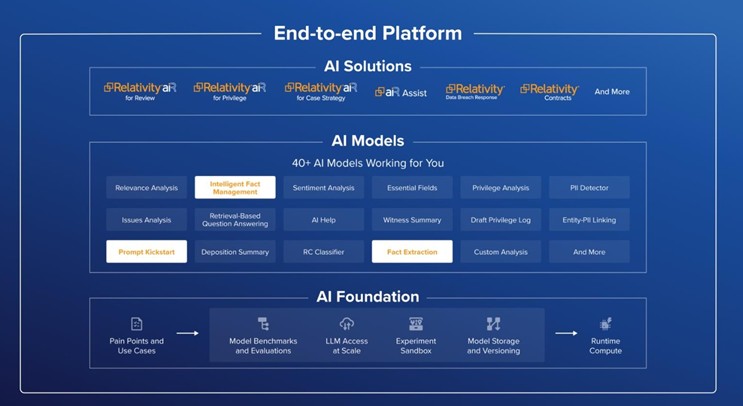
Relativity’s models, which are designed for different purposes, are meant to deliver the tailored insight/action each user needs – within its platform to power outcomes for a variety of legal data intelligence use cases. Custom analysis types on top of this can help drive these use cases forward. For too long, Relativity app and script development has been an ‘expert platform for experts’ while the front-end UI has become increasingly approachable. Partners frequently use their custom apps to entice hosting customers instead of licensing them into customer-owned RelativityOne tenants. Hopefully, the new Rel Labs initiative will open the doors of customer-driven innovation to meet the diverse use cases modeled by the Legal Data Intelligence project. If Relativity is going to be our System of Action, it must be approachable by real practitioners rather than expert developers alone. The Relativity team has made strong progress recently to simplify administration, automated workflows and template creation. That signals usability is a priority alongside AI-driven features.
Lindsey Lanier – Director, Product Management
Lindsey got granular with end-to-end administrative usability and workflow improvements. Here are my key notes:
- The new UIs for security and reports look SO much easier for administrators to manage.
- Having recently spent far too much time wrestling with permissions on workspaces with multiple overlapping reviews, I can testify to the challenges posed.
- Those of us who have burned far too many hours searching Relativity documentation are now supported by AI Help, a chatbot that surfaces content from documentation and the Community Site directly within RelativityOne.
- While I love this for admins and experts solving issues, I would love to see a tenant level chat based on a workspace with guidelines, templates, training materials, etc.
- Legal Hold has added preservation-in-place for Slack.
- Collect AI prompts and conversations and automatically convert to RSMF from OpenAI ChatGPT Enterprise, Microsoft Copilot and Google Gemini.
- Collect API to open upstream sources and expand functionality.
- Transcript with video synchronization for improved review of Teams meetings (which I am seeing pop up everywhere). Redaction for Teams is coming in 2026.
- Adding document comments in the viewer for more intuitive workflows and to capture counsel perspectives outside of formal review templates.
 Elise Tropiano – Senior Director, Product Management

While Elise did a fabulous job explaining aiR Assist, I covered most of this in the full Uncover Hidden Insights with aiR Assist write-up. aiR Assist is the new AI natural language query on specific data sets for fact analysis. Read the full session deep dive if this is your focus and you are eagerly awaiting the GA date.
 Chris Haley – Vice President, Practice Empowerment, aiR

Where Phil Saunders set the transformation goal, Chris Haley gave specifics on how aiR for Review and aiR for Privilege are challenging traditional first pass review approaches. In the first 20 months, 200+ customers have made 100M+ review predictions. Interestingly, while 37% are for traditional relevance production scenarios, 40% were for upstream early case assessment, investigation, or document prioritization scenarios.
That last figure held the key to transformation to me. After all, productions and trial should not be the actual goal in legal disputes. We know that only 1-2% of federal matters go to trial. Application of powerful, efficient AI tech upstream is justified if you can convince retained counsel to overcome their fear of review revenue loss.
What is coming down the pipe for aiR for Review?
- Flagging for sensitive business information and PII
- This feels like finally blending distinct apps for a broader general legal usage case.
- Custom aiR workflows to tailor or create model instructions, user inputs and results for unique use cases.
- aiR Templates allow you to manage the Relativity, Community and personal templated workflows.
- This would give you the building blocks to automate sequential aiR tasks like macros to populate issues, priv, PII and more to power more complex requirements.
- I love the idea of Community templates. Cannot wait for the Relativity App store…
 Jim Witte – Director, Product Management

Jim covered the advances in aiR for Case Strategy (Limited General Availability). Like Elise, his write up is being abbreviated in favor of my full piece from the lab on Case Strategy. For any Case Dynamics users, the new aiR-driven version is a life saver once you have rich sets of relevant documents. The automatic generation of ‘facts’ from sets feeds into witness, depo and matter summary reports. A good client recently reminded me that witness and depo prep can consume disproportionately large portion of billable time when matters reach this late stage.
Quality AI results are dependent on quality prompt criteria and selecting your target key documents. The lab made that look easy, but the real test will be how well it runs on an existing workspace and compares to counsel generated work product. The aiR summary reports are just drafts for counsel to work from. They are meant to eliminate search drudgery and support legal analysis rather than replace it.
Greg Buckles wants your feedback, questions or project inquiries at Greg@eDJGroupInc.com. Book a free 15 minute ‘Good Karma’ call if he has availability. He solves problems and creates eDiscovery solutions for enterprise and law firm clients.
Greg’s blog perspectives are personal opinions and should not be interpreted as a professional judgment or advice. Greg is no longer an investigative journalist and all perspectives are based on best public information. Blog content is neither approved nor reviewed by any providers prior to being published. Do you want to share your own perspective? Greg is looking for practical, professional informative perspectives free of marketing fluff, hidden agendas or personal/product bias. Outside blogs will clearly indicate the author, company and any relevant affiliations.
Greg’s latest nature, art and diving photographs on Instagram.